

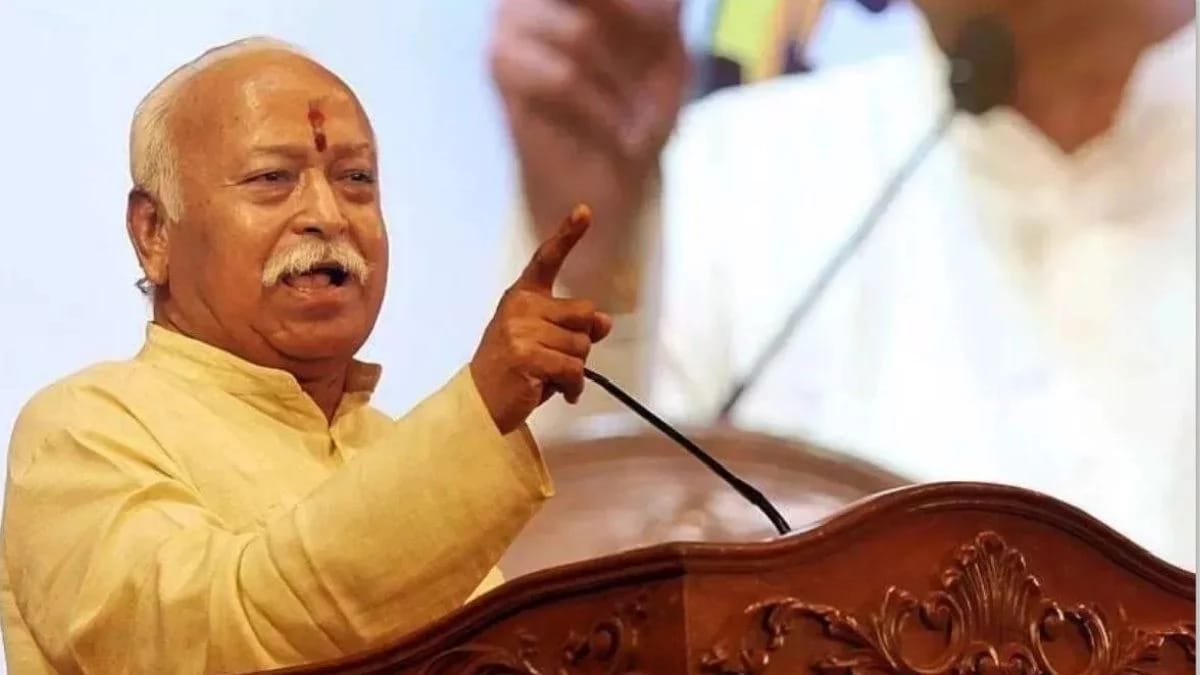
RSS Not Against Anyone, Does Not Seek Power: Mohan Bhagwat
Hind Samachar Exclusive
Mumbai: Rashtriya Swayamsevak Sangh (RSS) chief Mohan Bhagwat has asserted that the organisation is neither opposed to any individual or community nor does it aspire to acquire political power, clarifying the Sangh’s position amid ongoing national debates on the role of ideological organisations in a democracy.
Addressing a gathering during an RSS programme, Bhagwat stated that the Sangh was founded with the objective of nation-building and social harmony, not to participate in electoral politics or act as a pressure group. He emphasised that the RSS works to strengthen society through discipline, service and cultural values, and any perception of the organisation as power-seeking is a misunderstanding of its core philosophy.
“The RSS is not against anyone. We do not seek power, popularity or political authority. Our work is aimed at uniting society and contributing positively to the nation,” Bhagwat said.
Role of Ideological Groups
Bhagwat’s remarks have once again brought focus to the broader discussion on the place of ideological and cultural organisations within India’s democratic framework. He maintained that such groups play an important role in shaping social consciousness and encouraging civic responsibility, without directly engaging in political competition.
According to him, democracy is strengthened when ideas are freely expressed and debated, provided they remain within constitutional boundaries and promote social cohesion. He reiterated that the RSS does not interfere in political decision-making, even though individuals influenced by its ideology may choose different paths in public life.
Unity and Social Harmony
The RSS chief also underlined the organisation’s emphasis on unity, stating that India’s strength lies in its social harmony and shared cultural values. He called for dialogue and mutual understanding on sensitive national issues, warning against divisive narratives that could weaken democratic institutions.
Observers note that Bhagwat’s statement comes at a time when ideological organisations are increasingly being scrutinised for their influence on governance and public policy. While supporters view the RSS as a socio-cultural movement dedicated to national service, critics argue that its ideological reach has indirect political implications.
Continuing National Debate
Bhagwat’s clarification is likely to add momentum to the ongoing national debate on how ideological bodies should operate in a democratic society. As India continues to navigate complex political and social challenges, the balance between ideological influence and democratic accountability remains a subject of intense discussion.
For now, the RSS leadership maintains that its mission is rooted in service and societal unity, not the pursuit of political power.